
#Editorial #Diversity #Inclusion #SpecialNeeds #YRET
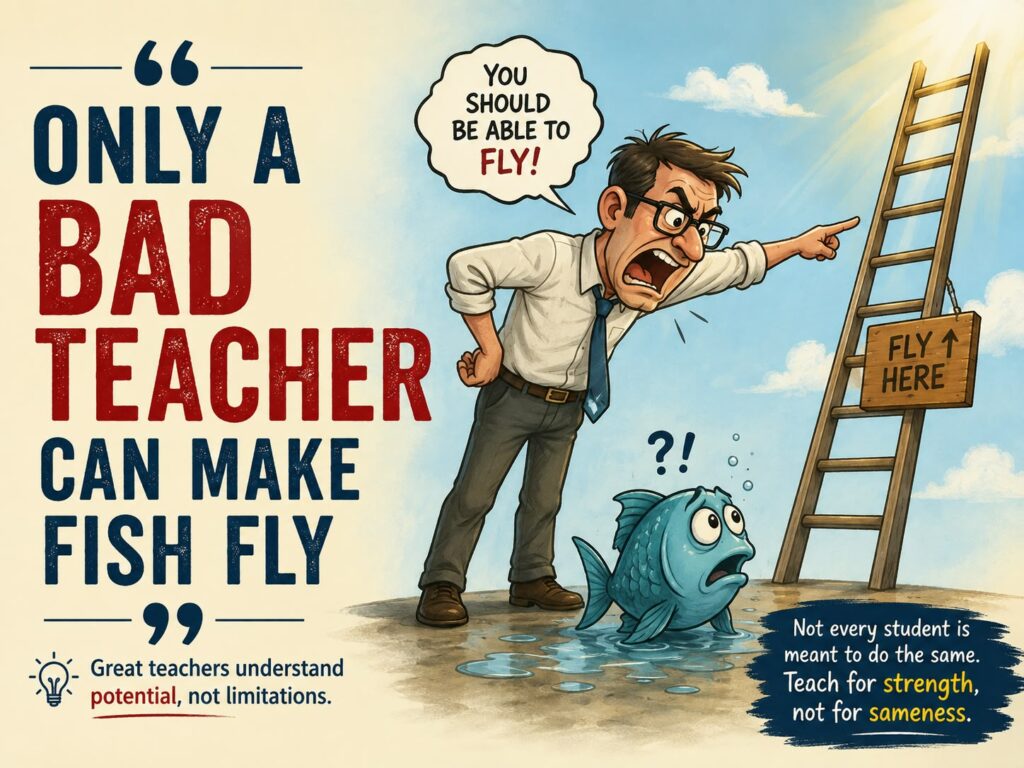
Every Indian educator knows the famous quote attributed to Albert Einstein: “Everybody is a genius. But if you judge a fish by its ability to climb a tree, it will live its whole life believing that it is stupid.” In modern Indian education, this poignant truth often gets lost beneath the crushing weight of high-stakes board examinations, rigid assessment models and one-size-fits-all curricula. To put it simply: only a bad teacher tries to make a fish fly.
Embracing the Spectrum of Learners in the Indian Classroom
Diversity in Indian classrooms spanning socio-cultural backgrounds, linguistic variations and distinct cognitive profiles is not merely a buzzword, it is an everyday reality. Yet, traditional schooling across the country has long operated on an industrial-era assembly-line model. As highlighted by successive educational frameworks, expecting every student to absorb identical material at an identical pace and output it in an identical format ignores human diversity.
When we cling to this uniformity, we penalize students whose strengths lie outside the narrow confines of rote memorization and standard testing. Ground realities mapped by the Annual Status of Education Report (ASER) consistently reveal wide disparities in foundational abilities across cohorts, proving that students cannot and should not perform the same way. Recognizing this diversity is the first step toward the equity envisioned by the National Education Policy (NEP) 2020, which champions individualized learning paths over rigid standardization.
The Shift in Modern Expression: Typing vs. Writing
Nowhere is this need for flexibility more apparent than in how India’s tech-forward generation communicates. Today’s students are growing up in a digitally pervasive landscape. Across urban and rural sectors, children are increasingly comfortable navigating touchscreens, typing on digital keypads and organizing thoughts via digital mediums.
For many modern learners, traditional pen-and-paper writing acts as a cognitive bottleneck. Their complex, rapid thoughts get trapped simply because physical handwriting speed cannot keep pace with their intellect. When schools enforce rigid handwriting mandates, they often mistake a barrier in motor-expression for a lack of conceptual understanding. Aligned with modern digital literacy goals, our classrooms must acknowledge that modern expression requires modern tools.
Tailoring the Path: Worksheets and IPEs
To bridge this gap and fulfill the promise of flexible education, Indian educators must pivot toward multi-dimensional teaching approaches powered by individualized planning and targeted resources:
Individualized Worksheets: Moving away from monolithic textbook chapters, custom-tailored worksheets can target specific learning gaps- accommodating diverse paces and allowing students to engage with material visually, textually or interactively.
Individualized Plans for Education (IPEs): By creating flexible roadmaps tailored to a student’s strengths-whether that means allowing typed submissions, digital concept mapping or oral presentations- we ensure that concept delivery and retention remain the core focus, rather than mechanical compliance.
Moving Forward
Our role as educators is not to force every student into the same rigid mold, but to provide the right environment for each unique mind to thrive. Let us stop handing out ladders to fish. Instead, let us design classrooms where every learner is given the exact medium they need to swim, soar and succeed.
Data Sources & References
National Education Policy (NEP) 2020: Guidelines on flexible, multidisciplinary and personalized learning frameworks.
Annual Status of Education Report (ASER): Citizen-led nationwide assessments highlighting diverse foundational learning levels and enrollment dynamics across India.
State of Elementary Education in Rural India Report (DIU / Transform Rural India): Data regarding student digital access, device usage patterns, and tech integration among school-going cohorts.